

In the Swedish 1800 MHz auction, completed in November 2025, half of the available spectrum in the band for which current licences expire in 2027 was offered. All three existing licences (Telia and Net4Mobility – a joint venture of Tele 2 and Telenor) took part, but only two won spectrum. As a result, the band is now evenly split between Telia and N4M with Tre not having any 1800 MHz spectrum.
This outcome challenges received wisdom in two important aspects:
- First, a claim often made when legacy spectrum comes up for reassignment is that it is best to just extend or renew existing licences because nothing changes anyway and competitive re-auctioning will only create costs for operators without changing the spectrum allocation. This is not the case in Sweden, where Tre has lost or given up the (small amount) of spectrum it held in the band.
- Second, another commonly held view is that operators ideally wish to hold spectrum in every band to hedge their bets. Having decided not to acquire any spectrum in this auction, Tre now is without 1800 MHz spectrum in Sweden. This could indicate a structural change in how spectrum portfolios are evaluated. Operators may increasingly prioritise fewer but deeper holdings in selected bands, particularly as carrier aggregation, refarming and deployment in higher frequency ranges reduce reliance on legacy spectrum.
For policymakers, this is an important signal: spectrum requirements are not static. Demand for specific bands evolves with technology, network architecture and traffic patterns. Rather than viewing auction-based reassignment as disruptive, policymakers may wish to recognise it as a necessary mechanism for periodic correction. Over time, renewal-by-default risks embedding inefficiency, whilst auction outcomes that differ from historical allocation patterns can reflect the changing market realities.
Of course, one also needs to look at the specifics of the Swedish case. On auction was only half the band and the available spectrum was fragmented. The non-expiring licences were held by Telia and N4M. There was no intention or no possibility to re-shuffle holdings within the band. The following diagram shows the pre- and post-auction band plan.
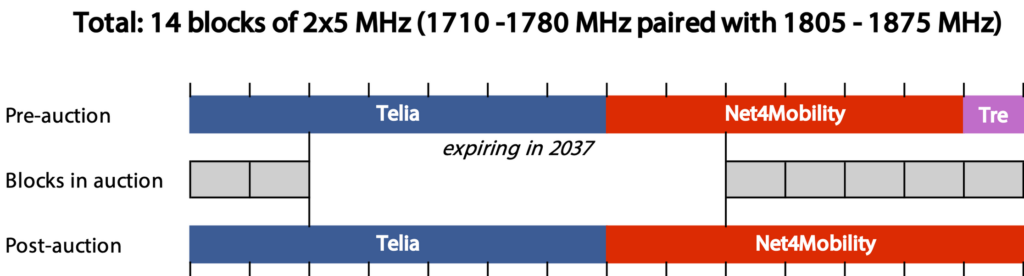
Given the spectrum assignment of the non-expiring licences, Telia may have had limited interest in bidding for more than the 2×10 MHz that it could acquire contiguous to its non-expiring holdings at the bottom of the band. N4M and Tre could both have acquired multiple contiguous blocks – in N4Ms case with its non-expiring holdings. However, the non-expiring holdings exposed bidders to the risk of ending up with non-contiguous assignments in different ways, so competition between bidders did not take place on a level playing field:
- Telia would be able to end up with a contiguous assignment provided it did not win more than two blocks.
- N4M could similarly expect to have a contiguous block if it did not bid for more than five blocks.
- Tre, however, could only win back more than one block in a contiguous assignment if only N4M reduced its demand by the number of blocks sought by Tre or if Tre only bid for two blocks and Telia dropped out of bidding entirely.
This meant that Tre faced much more uncertainty over whether it would end up with contiguous spectrum if it sought to expand its holdings in the band. This may well be the reasons for Tre’s decision not to pursue more spectrum in the 1800 MHz band and instead give up its single block and focus on other bands.
If this is the case, this would challenge another piece of received wisdom, namely that with growing support for in-band carrier aggregation contiguity of assignments becomes less important. It would also mean that non-expiring licences not being included in a general re-shuffling of assignments was a major weakness of the process (albeit one that might have been unavoidable).
The same problem will not arise when the remaining licences expire in 2037: even though the newly assigned spectrum licences will run for 27 years from 2027, the placement of licence holders in the band can be revisited after 10 years. This will allow a re-shuffling of holdings when the currently unexpired licences come up for renewal. Whether this will be enough to tempt Tre to return to the band remains to be seen but it is an outcome that an auction should be able to explore.